

New article by Dr. Sangeeta Mangubhai published by the journal World Development

We are delighted to share Dr. Sangeeta Mangubhai’s hot off the press article on “Progressing gender equality in fisheries by building strategic partnerships with development organisations” published by the journal World Development. This work was co-authored by Sarah Lawless, Anna Cowley, Jayshree Mangubhai and Meryl Williams
In this paper the authors highlight:
Note that this is the 4th in a series of open access papers on gender and fisheries in Melanesia led by Dr. Sarah Lawless and Dr. Sangeeta Mangubhai. The 3 countries (Fiji, Solomon Islands, Vanuatu) served as case studies, and our approaches and our findings may be of relevance to geographies beyond the Pacific.
We hope this work opens the doors to fruitful discussions on how we can collectively progress gender equality in the fisheries sector.
Gender equality, a universal agreed principle and value, has been adopted widely but implemented to varying levels in different sectors. Our study was designed to contrast how development and fisheries sectors view and invest in gender, and then explore opportunities to strengthen collaborative relationships and networks between the two, with the aim of improving capacity for gender inclusion in practice in fisheries. We conducted key informant interviews with fisheries (n=68) and development (n=32) practitioners (including managers) in Fiji, Solomon Islands and Vanuatu between 2018 and 2019. We found three points of divergence between fisheries and development practitioners and/or their organisations when it comes to the inclusion of gender into their work: (1) fundamental differences in organisational motivations for working on gender ‒ (i.e., fisheries organisations viewed gender equality as a means to achieve fisheries objectives (instrumental), while development organisations viewed it as a core value or principle (inherent); (2) fisheries practitioners had comparatively little to no access to qualified gender focal points and training, and limited networks with gender experts; and (3) differences in what each considered successful versus failed approaches to gender integration. Our findings illustrate opportunities, as well as limitations or challenges (e.g. resistance and indifference), to transfer knowledge and capacity to integrate gender into fisheries policies and practice. We suggest using these divergences to ‘pivot change’ in the fisheries sector by building on decades of knowledge, learning and experience from the development sector focusing on four areas for strategic partnership: (1) shifting values; (2) gender mainstreaming; (3) adopting gender best practice; and (4) investing in gender networks and coalitions. We argue that fundamental to the success of such a partnership will be the ability and willingness of fisheries and development practitioners and their organisations to break down silos and work collaboratively towards gender equality in the fisheries sector.
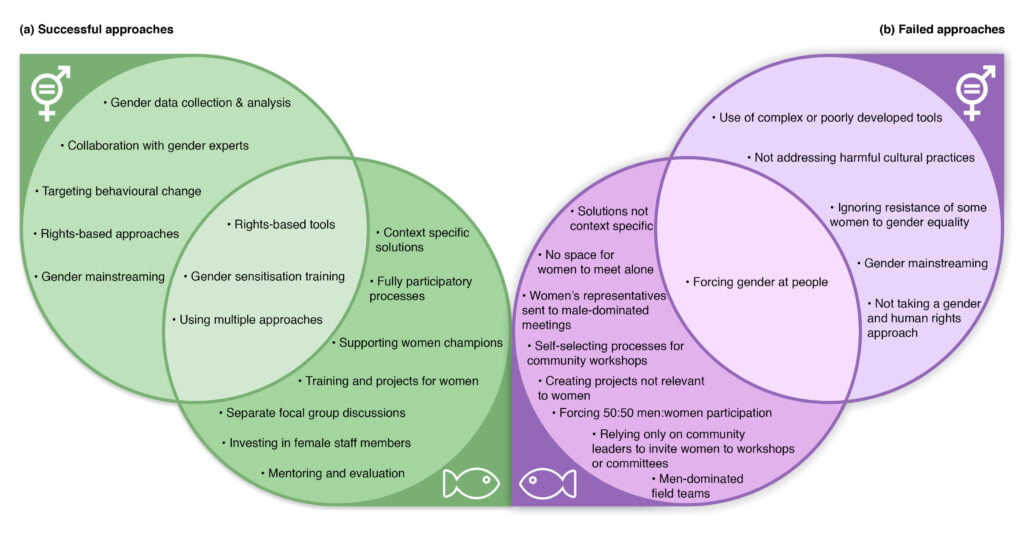
Photo: Female fisher. Credit: Tom Vierus